



LLM Fine-Tuning & Model Customization
Purpose-built AI models trained on your data, tuned for your exact use case.
Off-the-shelf AI models are general-purpose, but many business problems need more precision, consistency, or domain knowledge than a generic model can offer. Fine-tuning and custom model development adapt a base model to your specific data, tasks, and tone, or build a purpose-built model from the ground up. This service focuses on delivering models that perform reliably on your exact use case, at a cost and latency that make sense for production.
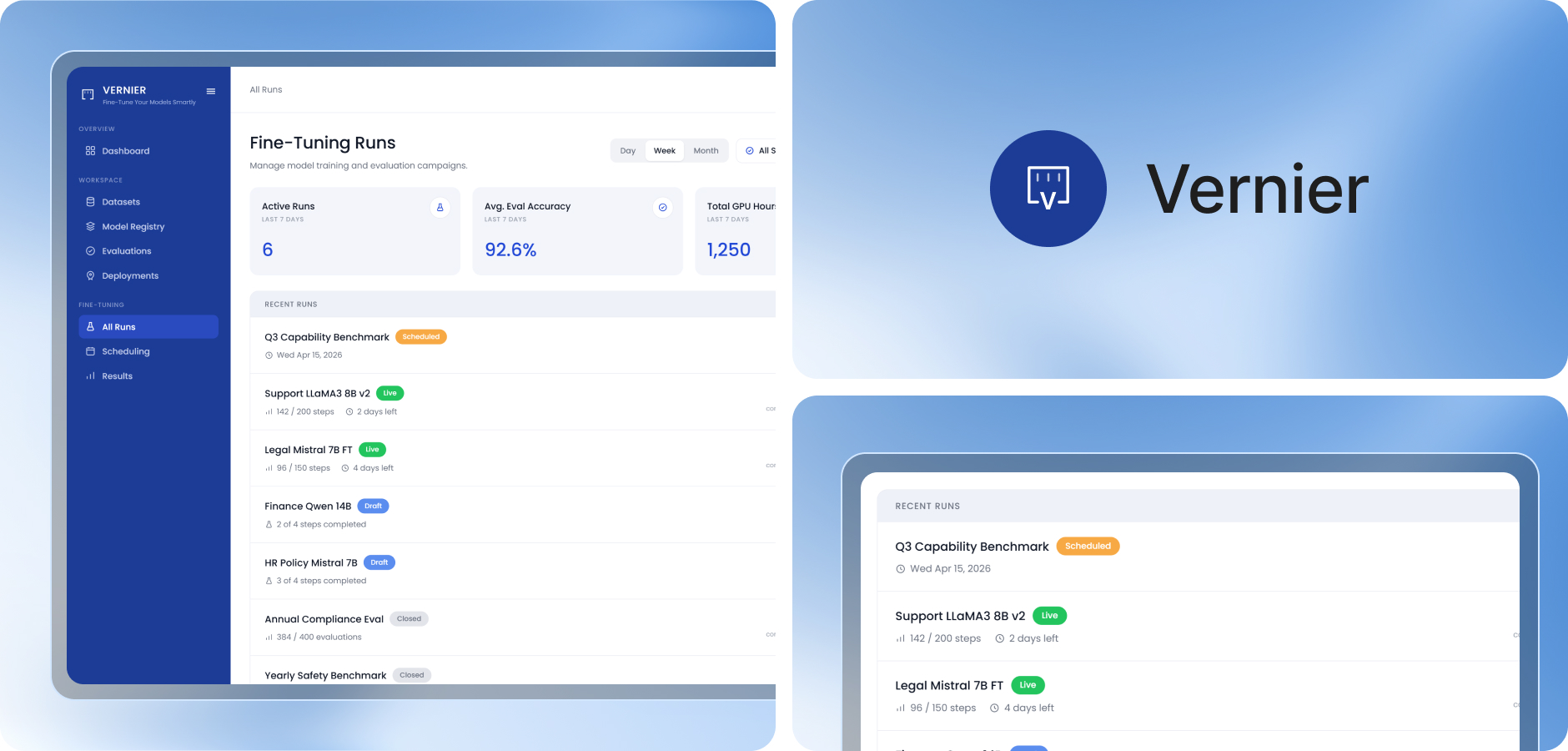
- Companies whose use case needs more accuracy or consistency than general models provide
- Businesses with proprietary data or terminology that generic models don't understand well
- Teams needing lower latency or lower cost than large general-purpose models allow
- Regulated industries requiring predictable, auditable model behavior
- Product teams wanting a defensible AI capability competitors can't easily replicate
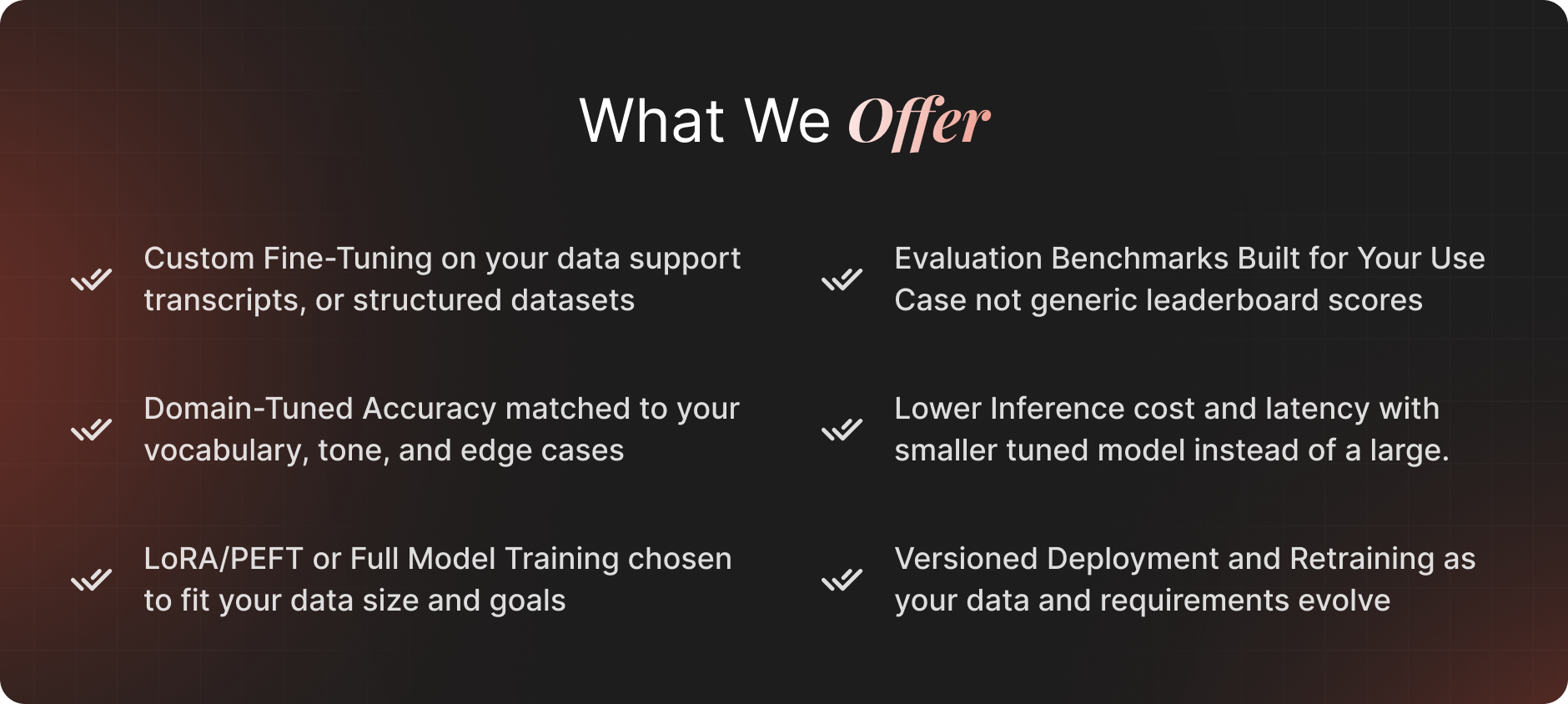
Common use cases include fine-tuning a model to match your brand voice and domain vocabulary, training a classifier for tasks like support ticket routing or document categorization, and building a custom model for specialized tasks such as legal or medical document analysis. Fine-tuning also helps reduce hallucinations on domain-specific questions, cut inference costs by using a smaller tuned model instead of a large general one, and improve performance on structured outputs like extraction or scoring tasks.
We work with leading base models (OpenAI, Claude, Gemini, Llama, and others) and apply techniques such as supervised fine-tuning, LoRA/PEFT, or full model training depending on your data size and goals. We prepare and clean your training data, set up evaluation benchmarks specific to your use case, and run training with careful monitoring for overfitting and bias. The resulting model is deployed via API or hosted infrastructure, with versioning, evaluation dashboards, and a retraining pipeline for continuous improvement.
Share the task you want the model to perform and examples of correct versus incorrect outputs. Provide your training data such as historical conversations, documents, labeled examples, or domain content, along with any compliance or data-handling requirements. You can also define performance benchmarks, edge cases the model must handle correctly, and constraints on model size, hosting, or cost.


