Sports Platforms That Feel Alive - Live Scoring, Tournament Energy, Color Psychology and AI


In sports, the product is not only the match. It is the moment. The tension. The comeback. The last 10 seconds when everything changes.
And today, most of those moments are experienced through a screen.
Over the last 2 years, we have been actively building solutions in the sports industry, especially around tournaments and live scoring. We have delivered platforms for
While building these systems, we learned something important: sports software is different from normal software. A standard dashboard can be “good enough.” A sports scoreboard cannot. Because sports users do not just view the UI once. They stare at it every few seconds, sometimes every second.
Many sports platforms struggle because they are built using the same logic as generic dashboards. They may look modern, but they lack structural clarity under stress. Score updates lag during peak traffic. Brackets refresh inconsistently. Schedules ignore real-world constraints. Interfaces overload users with information instead of guiding attention.
In sports, users glance at interfaces for less than a second. They want instant answers:
A sports platform is not a collection of isolated screens; it is a connected ecosystem where every layer influences another. Live scores feed bracket progression. Bracket updates influence scheduling. Scheduling affects court allocation. Court allocation impacts match timing and fan engagement. When these elements are not integrated thoughtfully, operational friction quickly appears.
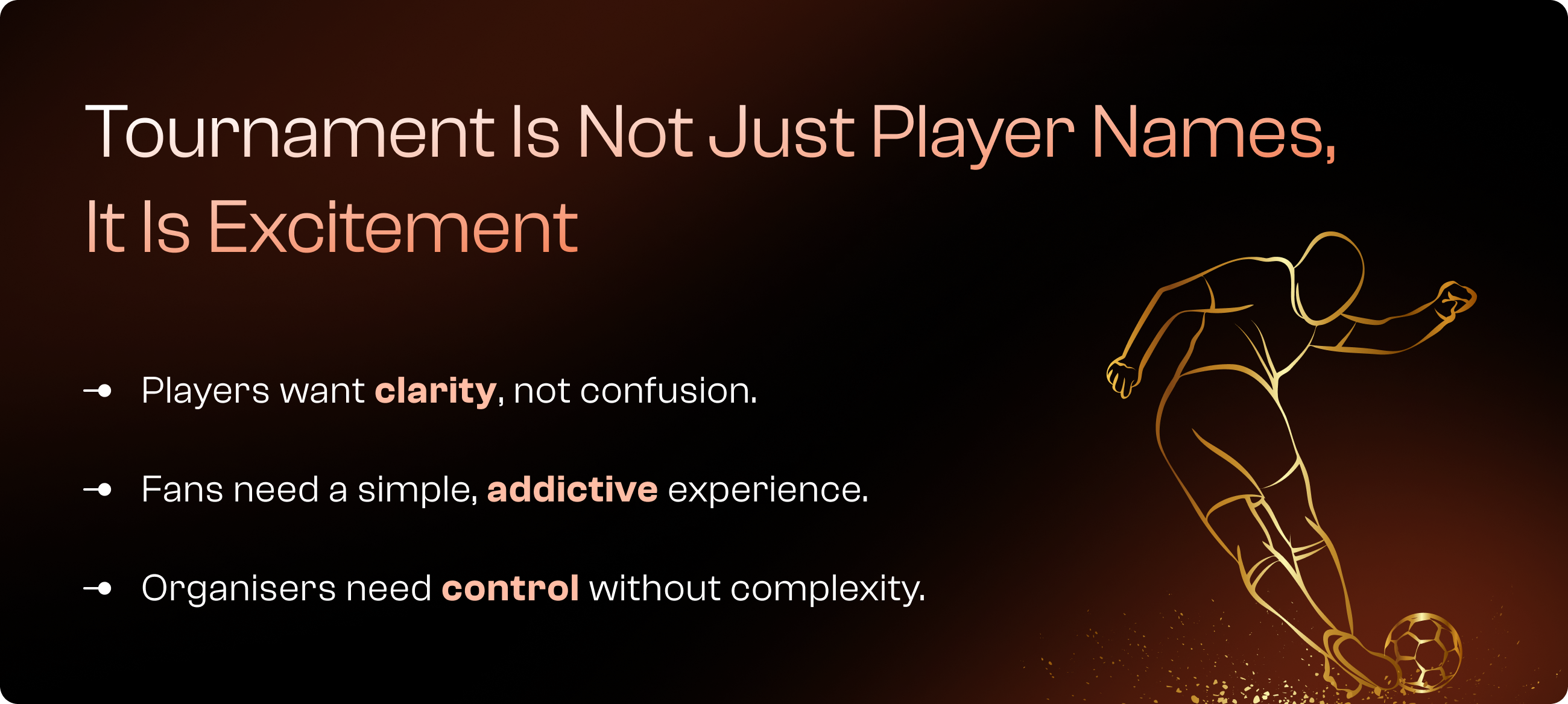
True system thinking requires designing for three audiences simultaneously:
A well-designed sports system balances all three without overloading any one interface. That balance is what separates a basic tool from a premium platform.
Execution is where credibility is won or lost. Strong design must be supported by resilient backend logic that respects real-world unpredictability. Real-time synchronization across devices, role-based permissions for scorers, validation rules to prevent impossible scoring scenarios, and transparent activity logs are not optional features - they are foundational requirements.
A strong execution layer means:
Tournaments run within real-world limits - limited courts, fixed match durations, referee availability, and peak hours. If software ignores these, it creates confusion instead of control.
Strong execution reduces manual fixes, avoids coordination chaos, builds trust, and keeps match day running smoothly.
Color in sports platforms is not decorative; it is functional and emotional at the same time. High-contrast interfaces improve readability across different lighting conditions and device types. Dark themes paired with bold accents allow scores and key events to stand out instantly, supporting rapid scanning behavior.
Accessibility must remain central. Contrast ratios, typography hierarchy, and spacing are not aesthetic details - they are performance factors.
In sports UI, clarity equals speed.

Technology should enhance sports platforms by simplifying operations and strengthening engagement rather than adding complexity. When applied thoughtfully, AI and intelligent systems can transform raw match data into dynamic content, generate automated summaries, personalize fan experiences, and optimize scheduling flows.
Intelligent Match Summaries
When AI is applied thoughtfully, a sports platform becomes more than a management tool — it becomes an intelligent, engaging ecosystem.
.png)
Final Thought: Sports Software Must Feel Like the Sport
Sports software must feel like the sport itself - fast, clear, dynamic, and reliable under pressure. When designed and executed correctly, a sports platform becomes more than software. It becomes the digital arena where the sport lives. And on match day, that experience must perform without compromise.